


FSC and PEFC certified wood: a sustainable and responsible choice
Henry Timber places great importance on the selection of its suppliers and the origin of its purchases. Indeed, we purchase PEFC or FSC® certified wood as well as wood from responsibly and sustainably managed forests.
RBUE
The European Union Timber Regulation (EUTR) is the European Union’s essential tool for combating illegal timber. In effect since March 3, 2013, it prohibits the marketing and movement of illegally harvested timber. Compliance with the EUTR is mandatory for all timber imports.
To this end, we have implemented an active vigilance approach, formalized in a due diligence system, consisting of three stages:
- Information collection
- Risk analysis
- Risk mitigation
Thus, for each purchase outside the European Union, we assess the risk that the timber is of illegal origin and reduce it if necessary.
FLEGT (Forest Law Enforcement, Governance and Trade) is an agreement between a country and the EU. Currently, only Indonesia has this agreement, which ensures the legality of timber sold by Indonesia under the EUTR.
LCB CSR Commitment Charter
We adhere to the Timber Trade (LCB) CSR Charter. This charter is based on the United Nations Sustainable Development Goals (SDGs) and comprises three pillars:
Sustainable sourcing: reducing environmental and social impacts at all stages of the purchasing process
Responsible sales: based on transparent communication, enabling consumers to purchase products with clear characteristics and known origins
Operations management: through a CSR policy, with initiatives to measure and reduce carbon impact, promote the circular economy, and promote social inclusion.
CSR performance is audited by an independent organization and accompanied by a distinctive logo with a score ranging from A to E. We have achieved the highest score of A.
See the LCB environmental charter website

OLB
The Timber Origin and Legality certification developed by Bureau Veritas guarantees the legality of timber purchases, an element that cannot be separated from knowledge of the geographical origin.
OLB is an international system based on:
Strict and comprehensive legality
A traceability requirement tailored to forestry companies
Simple and effective timber tracking (chain of custody)
OLB certification is, above all, recognition of the legality of timber harvesting conditions and their subsequent monitoring within the industry.
PEFC
PEFC (Programme for European Forest Certification) is a forest certification system with a standard that promotes a balance between environmental, societal, and economic issues.
It aims to improve sustainable forest management through a voluntary process of continuous improvement. Forest certification does not provide guarantees regarding technological qualities, but promises to ensure environmentally friendly, socially beneficial, and economically viable forest management.
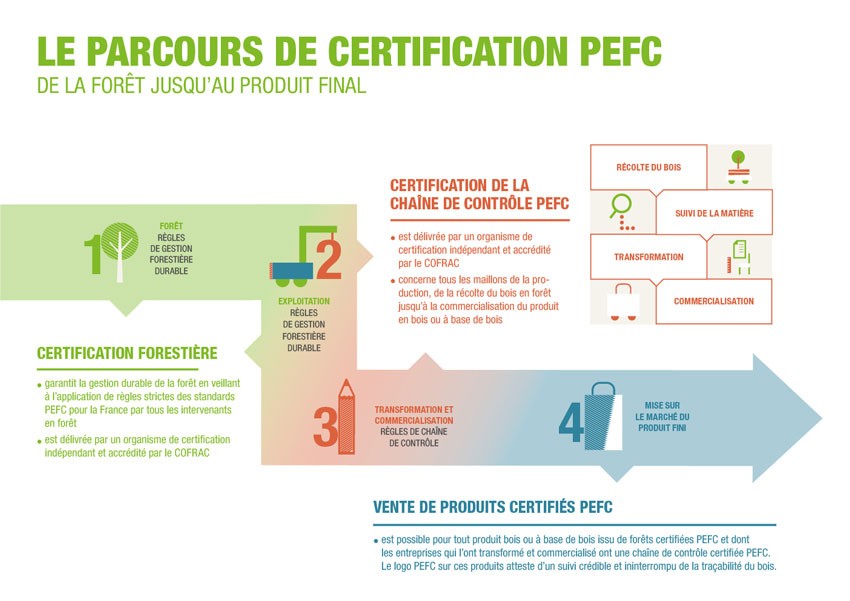
The certification takes into account all stages of the forest process, including the finished product:
Forest: Sustainable forest management rules
Logging: Sustainable forest management rules
Marketing and processing: Chain of custody rules
Marketing of the finished product
See PEFC certification: audit and control procedures | PEFC
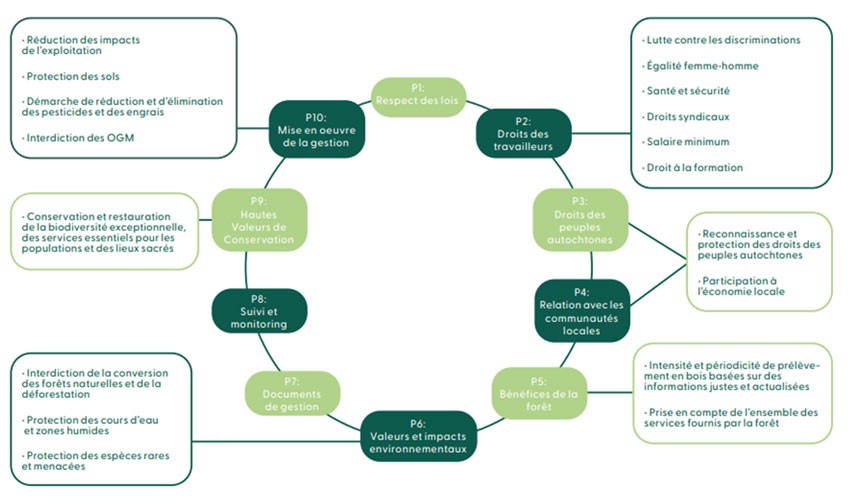
FSC
The Forest Stewardship Council® is a non-governmental organization created in 1993, one year after the Rio Earth Summit, by a group of businesses, environmental associations (including WWF), and social rights representatives.
Its mission is to create and promote an independent and effective certification system for all types of forests (boreal, tropical, and temperate).
Regular monitoring of certified forests and companies by an independent third party ensures the application of responsible management specifications.
Thus promoted through a demanding label, the values of forests are better shared and preserved.
Chain of Custody | Forest Stewardship Council (fsc.org)
Bois de France
The BOIS DE FRANCE label guarantees the origin and processing location of the wood. It is a token of recognition for the work of the French forestry and timber industry.
Today, wood users are increasingly paying attention to the origin and processing location of their wood.
The relocation of the economy is a given, as is short-circuit consumption.
With the BOIS DE FRANCE label, the wood production, processing, construction, and industrial sectors can provide these guarantees and thus address today’s significant environmental and societal challenges.
At Henry Timber, we have chosen to work with French wood, and we are proud of it!
Our certified woods:
- Oak blocks
- Ash blocks
- Round beams
- Steel planks
- Douglas fir frames
- Spruce frames
- Glued Douglas fir beams
- Douglas fir deck boards
- Joists, joists, planks, beams, red planks, squared beams, battens, and fir formwork boards
RE2020
Construction is the leading sector in terms of energy consumption, accounting for 44%.
75% of the CO2 emitted by a building comes from the construction phase.
The major challenge of the 2020 Environmental Regulation is to significantly reduce carbon emissions from buildings and put the sector on the path to carbon neutrality. The regulations are based on a gradual transformation of construction techniques, industrial sectors, and energy solutions.
This building regulation aims to control the energy consumption of new buildings with three objectives:
Buildings that consume less and use less carbon-intensive energy sources
Ensuring a gradual transition to low-carbon construction, focusing on a diversity of construction methods and a mix of materials
Buildings that are more pleasant in hot weather
2020 Environmental Regulation – RE2020
The carbon footprint
The purpose of conducting a carbon footprint assessment is to assess the amount of greenhouse gases emitted into the atmosphere by human activities.
To conduct this assessment, data on the organization’s activities must be collected: raw materials and energy purchased, employee travel, customer use of products, end-of-life, etc.
Companies can use Life Cycle Assessment (LCA) to determine the environmental impacts of products at each stage of their life cycle.
The Carbon Footprint Assessment allows companies to quantify their carbon footprint by highlighting the main sources of emissions (energy consumption, transportation, purchasing, waste, etc.) and to implement strategic actions to reduce it.
FDES
An Environmental and Health Declaration Sheet (EHDS) is a document that presents a product’s environmental indicators and health information.
There are different types of EHDS:
Range EHDS: covers one or more products
Individual EHDS: covers a product manufactured by one manufacturer
Collective EHDS: covers a product manufactured by several manufacturers
An EHDS is a multi-page document:
The first pages are dedicated to general information about the manufacturer, the product, and the EHDS.
The following pages describe the life cycle stages, the processes considered, and certain methodological assumptions.
The core of the EHDS consists of tables presenting the environmental indicators by life cycle stage.
The last pages present health and comfort information.
EHDS are verified and validated by an independent third party and are valid for 5 years. They are available in the INIES database.
Link to the INIES website (explanatory video): EHDS (Construction Products) – INIES
See the available collective FDES (FR) :
Bardage :
FDES Bardage durable
FDES Bardage traité
FDES Bardages en lames de bois de France
Construction :
FDES Élément porteur résineux en bois de France
FDES Élément porteur feuillus en bois de France
FDES Élément d’ossature en bois de France
FDES Charpente industrielle et fermette en bois de France
FDES Charpente traditionnelle en bois de France massif
Menuiserie/agencement :
FDES Plinthe en bois de France
The advantages of wood in construction
Bio-sourced material: wood is an infinitely renewable raw material
Less waste and less water: the wood industry is a dry industry
Lightness: wood is 5 times lighter than concrete (truck rotation divided by 8)
Carbon benefits: Wood traps carbon; 1 ton of wood used saves 1 ton of CO2 compared to concrete
Technical material: wood is fire-resistant and insulating
Acoustic benefits
Proven positive effects on health: the presence of wood reduces our blood pressure and heart rate
A growing forest can absorb 11 to 37 tons of CO2 per hectare per year.
Carbon storage time in wood products:
| Marché de destination finale | Emballage | Gros oeuvre | Second oeuvre | Meuble |
| Exemples de durée de vie type | 8 ans (palette) | 100 ans (charpente, mur, ossature bois) | 30 ans (fenêtre) ou 100 ans (parquet massif) | 20 ans (table, meuble de cuisine) |